


Southern Voices: Reflections on Five Years of Community-Centered Data Projects
Everyone belongs in policymaking conversations and have released a report highlighting what we’ve learned through years of community-centered data projects.
Policy Entrepreneurs Program is accepting applications! Apply now through Feb. 20th!

Everyone belongs in policymaking conversations and have released a report highlighting what we’ve learned through years of community-centered data projects.

This report draws on insights from over 50 stakeholders on how this grant opportunity galvanized Southern leaders.
Southern cities, including Richmond, VA, Charlotte, NC, Louisville, KY and Sarasota, FL identified as examples of participatory climate planning excellence.
SEAP recently wrapped up its support for the inaugural Our Dollars, Our Dreams community — New Orleans, LA. We assisted the Building Equity Collaborative in
This report details the impacts of climate change and the potential for federal investments to alleviate them. The report focuses on Southern communities, which are particularly at risk.
The new Climate Pollution Reduction Grants (CPRG) provide $250 million in planning grants and $4.6 billion in implementation grants to states, local governments, tribes, and
The Infrastructure and Investment Jobs Act (IIJA) and the Inflation Reduction Act (IRA) offer states and cities funding opportunities for infrastructure improvements across all areas,

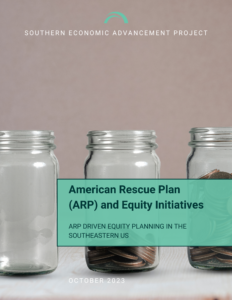
The term “equity initiatives” is vague as it encompasses incredibly broad categories and interdependent institutions such as the built environment, distribution of resources, transportation, and
This report dives into how current real estate processes can exacerbate existing inequalities during disaster recovery.
Today, the Southern Economic Advancement Project (SEAP) released its report, Engagement & Equity First: Opportunities and Challenges for Federal Funding Implementation, which aims to identify innovations and challenges among local governments and nonprofit organizations as they implement federal recovery funds. Identifying and resolving these can bring more community voices to the table for spending decisions and produce more equitable outcomes that will change the landscape of many Southern communities.